
When Christmas Hurts: Making Space for Grief During the Festive Season
Christmas is often described as the most wonderful time of the year. A season of joy, togetherness, celebration and connection. Everywhere we look, there are reminders of how Christmas is supposed to feel. The familiar songs, the decorations, the gatherings and the expectation that we should all be feeling happy. But for those experiencing grief, Christmas can feel very different.
It can be a time when the absence of someone we love feels particularly present. When familiar traditions bring a mixture of warmth and sadness, and when the pressure to celebrate feels at odds with what we are experiencing inside.
Sometimes, it is the smallest things that catch us off guard. A favourite Christmas song playing in a shop. An ornament that holds a particular memory. A familiar smell, an old photograph, or the empty space at the dinner table where someone once sat. These moments can remind us not only of who we have lost, but of the life we shared with them, and that can feel incredibly painful.
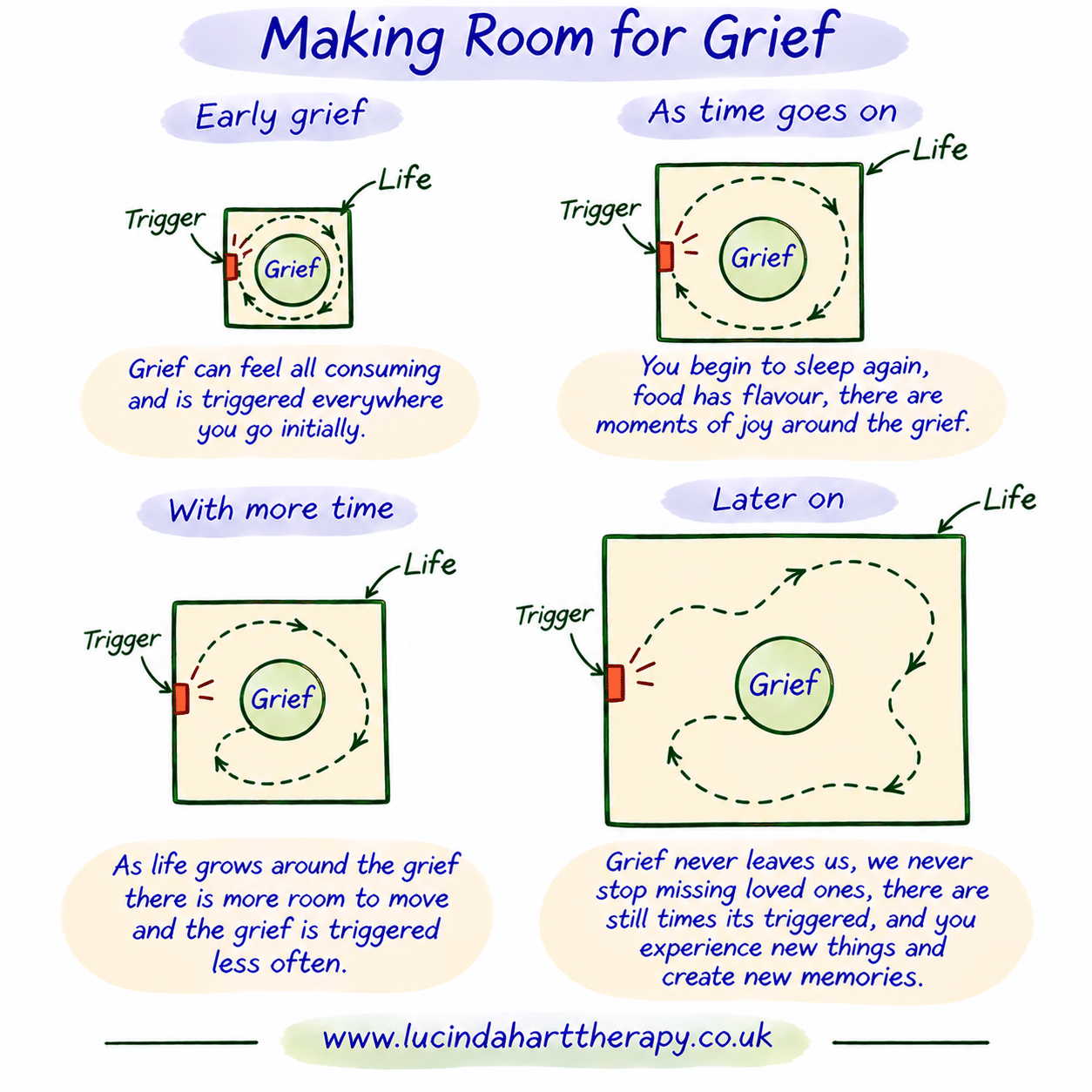
Making Room for Grief: Growing Around Loss
Sometimes, when we think about grief, we imagine that as time passes, our sadness should gradually become smaller. That somehow, with enough time, we will miss someone less or reach a point where their absence no longer hurts.
But perhaps grief doesn’t always work that way; there is an idea about grief that I find particularly meaningful: rather than grief becoming smaller, our lives can gradually grow around it.
In the early days of loss, grief can feel all-consuming. It can fill almost every part of our world. The smallest things can bring painful reminders, and it may feel impossible to move through an ordinary day without encountering something that brings our loss sharply into focus.
Over time, however, there may be moments when life begins to open up again. Perhaps we begin sleeping a little better. Food starts to have flavour again. We find ourselves laughing unexpectedly, enjoying a conversation or noticing something beautiful.
These moments don’t mean that we have forgotten the person we love, or that our grief has disappeared. They simply mean that other experiences are beginning to find space alongside it.
I think this can be a particularly helpful way of understanding grief at Christmas. Even when our lives have grown around a loss, Christmas can bring us unexpectedly close to that button again. A familiar song, a family tradition, an empty chair or a memory of Christmases gone by can suddenly bring feelings of sadness and longing. That doesn’t mean we have gone backwards or that we aren’t coping, it simply means that someone mattered deeply to us, and that their absence is still felt. We can continue to miss someone while also experiencing moments of happiness.
Grief Is About More Than Bereavement
Although we often associate grief with the death of someone we love, loss can take many forms. Christmas may bring feelings of sadness for a relationship that has ended, family connections that have become strained, or a sense of belonging that is no longer there. For some, it may be a reminder of a childhood they wish had been different, a family they longed to have, or a future they had imagined that hasn’t unfolded as hoped. For others, changes in health, circumstances or relationships may mean that Christmas no longer looks or feels the way it once did.
These losses may not always be visible to those around us and sometimes, we may struggle to give ourselves permission to grieve them because they don’t fit with what we think grief should look like. Yet the feelings associated with these experiences can be very real; there doesn’t have to be a death for there to be a sense of loss.
Giving Yourself Permission to Do Christmas Differently
Christmas often comes with traditions, expectations and a sense of how things should be. We may feel responsible for keeping everyone else happy, maintaining family routines or recreating celebrations from previous years. But when we are grieving, what once felt comforting may now feel difficult or overwhelming.
It can be helpful to remember that we are allowed to do things differently. Perhaps that means spending Christmas somewhere new, changing a familiar tradition or choosing a quieter day. Perhaps it means accepting an invitation but giving yourself permission to leave early. Or deciding that this year you simply don’t have the emotional energy to celebrate in the way you usually would.
You might want to be surrounded by people, or you might need time and space on your own. There is no correct choice and you don’t have to justify your needs simply because they are different from what others might expect.
Sometimes, being compassionate towards ourselves means recognising our limits and allowing those limits to matter.
Being Gentle with Yourself This Christmas
If you are grieving this Christmas, perhaps the most important thing you can offer yourself is kindness. Not the kind that expects you to feel better or encourages you to look for the positive in everything, but a gentler kind of compassion; the kind that allows you to acknowledge when something is difficult.
That recognises you may need rest, connection, quiet or support and that doesn’t criticise you for finding things harder than you expected. You don’t have to make Christmas magical. You don’t have to feel grateful for every moment. You don’t have to pretend that everything is okay.There Is No Right Way to Do Christmas
Perhaps this Christmas doesn’t need to be about finding joy in every moment, keeping every tradition alive or making everything feel as it once did. Perhaps it can simply be about allowing yourself to be where you are; to miss someone, to remember, to laugh when laughter comes, to cry when tears arrive, and to know that neither takes anything away from the love you carry.
You may find comfort in familiar things, or you may need to create something entirely different. Whatever this Christmas looks like for you, I hope you can find moments of gentleness towards yourself. Because grief doesn’t disappear simply because the calendar tells us it is time to celebrate and you don’t have to set your grief aside to make room for Christmas.
If You Need Some Support
If grief feels too heavy to carry on your own this Christmas, talking to someone can help. I offer counselling for grief, loss and life changes, in person in Banbury or online across the UK. You’re welcome to get in touch for a free 15-minute conversation.
If you need support over the holidays:
- Cruse Bereavement Support: free helpline 0808 808 1677 (check opening hours; they change over Christmas)
- Samaritans: call 116 123, free, 24 hours a day
- Shout: text SHOUT to 85258, free, 24 hours a day
- If you feel unable to keep yourself safe, call 999 or go to A&E.
